

16 Then the eleven disciples went to Galilee, to the mountain where Jesus had told them to go. 17 When they saw him, they worshiped him; but some doubted. 18 Then Jesus came to them and said, “All authority in heaven and on earth has been given to me. 19 Therefore go and make disciples of all nations, baptizing them in the name of the Father and of the Son and of the Holy Spirit, 20 and teaching them to obey everything I have commanded you. And surely I am with you always, to the very end of the age.” [Matthew 28:16-20, NRSV]
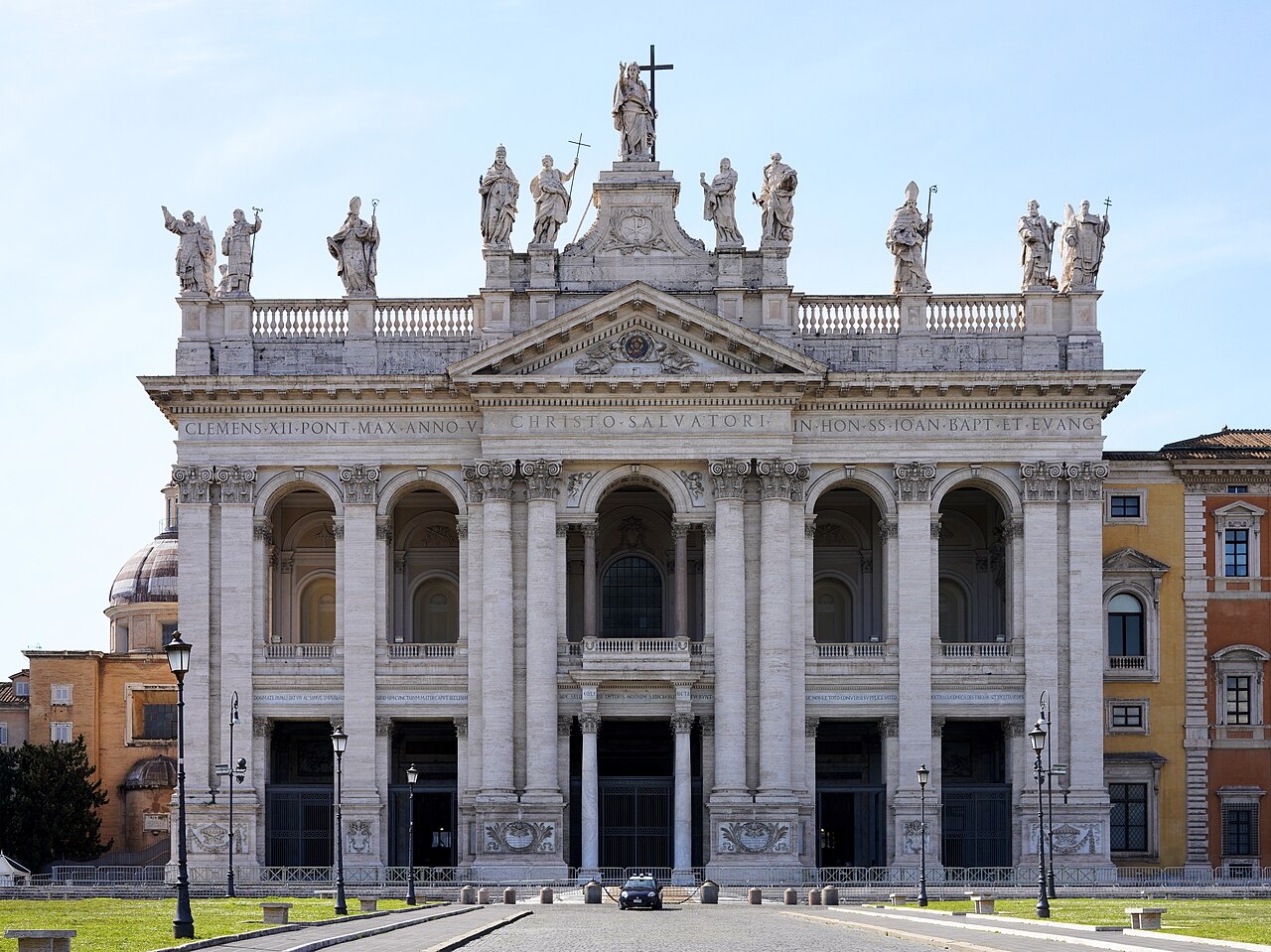
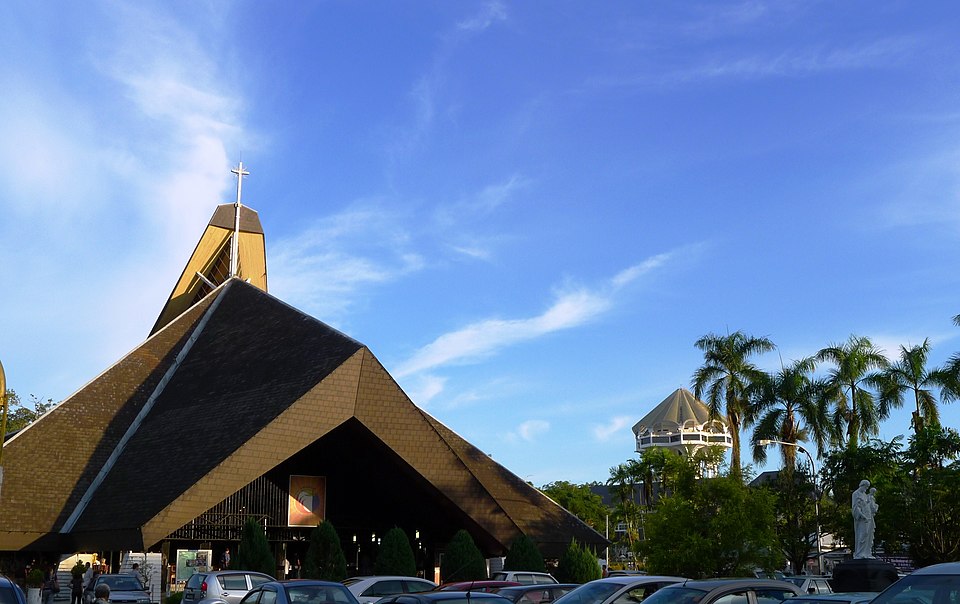
[L] Main façade of Archbasilica of Saint John Lateran, Rome. [R] St Joseph’s Cathedral, Kuching, Sarawak, Malaysia.
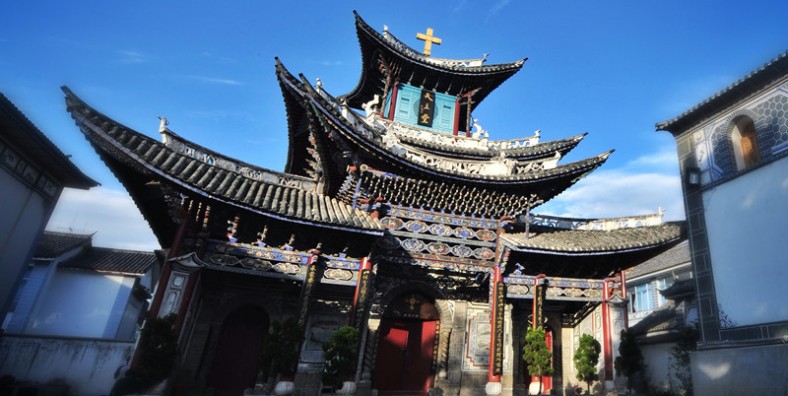
Catholic Church of Dali Ancient Town, Yunnan Province, China.
Created by Pope Pius XI in 1926 as the day of prayer for missions, World Mission Sunday is celebrated on the penultimate Sunday of October every year. It is a day set aside for the Catholic Church throughout the world to publicly renew its commitment to the missionary movements, coordinated by the Pontifical Mission Societies, who are also known as Missio. They remind us of Peter and John who, in the early days of the Christian movement defiantly told the Jewish religious rulers, elders and scribes, “We cannot but speak about what we have seen and heard” (Acts 4:20). These early Christians were driven by the conviction, born initially of the experience of personal encounter with Jesus of Nazareth. This was strengthened by the abiding and revelatory presence of the Holy Spirit since Pentecost, that “there is salvation in no one else, for there is no other name under heaven given among men by which we must be saved” (Acts 4:12). This conviction was evident at the start of the Christian movement.
Church buildings from time immemorial are thus meant to embody a missionary spirit anchored in this conviction. They celebrate a profound truth, namely, that God chooses to dwell among His people in all cultures. To all cultures, churches announce that the kingdom of God is close at hand, calling for repentance and for conversion of hearts and minds. We have recently been detained in reflection among friends on three representative church buildings.
First, is the cathedral of the Bishop of Rome and the “mother and head of all churches”, the St John Lateran Basilica. It is a basilica of European architecture, of the period around mid-18th century. Featuring a blend of Baroque and Neoclassical design and a typical iconic Neoclassical façade, it reminds us that far from being dead structures of cold stones, church buildings ought always lead us from physical temple to the human heart, from structure to spirit. Worship, particularly communal worship, must above all be about communion. Attendance at a worship service in a church building must never reduce us to mere visitors to the temple, for we ourselves are the temples of God and God’s Spirit dwells in us (1 Cor 3:9, 16). Stones and marbles do not welcome the divine; eager hearts do.
The second building is our very own Cathedral of St Joseph’s in Kuching, Malaysia. Built in 1969, barely four years after the Second Vatican Council (1962-1965), it is stunning to say the least: its beauty and architecture reflect the defining essence, theologically speaking, of what it means to be Church. Timeless and universal, it is the most “proper” church building one can theologically imagine — magnificent while free from the shackles of colonialist past and an untrammeled desire to flaunt in external exhibition.
- The principal term adopted in the Council document Lumen Gentium (Dogmatic Constitution on the Church, promulgated 21 Nov 1964) for the Church is The People of God. Chapter 2 of this document describes the Church as a unified community of believers, reborn in Christ through baptism, and sharing in his priestly, prophetic, and kingly roles. Equality in dignity is underscored, as well as a common mission for all members, laity, religious and clergy alike. This People of God is described as a pilgrim people: “While on earth she journeys in a foreign land away from the Lord (cf. 2 Cor 5:6), the Church sees herself as an exile.”
A friend from another part of Malaysia visiting Kuching recently, remarked that he was delighted to experience a Mass-attendance in St Joseph’s Cathedral where the altar is smack in the middle surrounded by the congregation. Indeed, shaped like a pilgrim’s tent, St Joseph’s Cathedral in Kuching invites us to always remember our pilgrim status on earth. The interior of the cathedral is no less theologically stunning as well. So soon after the liturgical reformation of the Second Vatican Council, it is a sheer delight to see the altar standing right in the middle of the covered space. Stunning and delightful is the image of the whole Pilgrim People of God surrounding the altar, actively participating in a worship service led by a presider chosen from amongst them, and not watching as mere spectators from the far end of a long nave. It is a celebration that urges us to remember (memoria), to give thanks (eucharistia), and to be sent forth to serve (diaconia). Architecturally sound for a proper Vatican II church, it avoids the pitfalls of a grand western design of bygone era that is often expensive to build and costly to maintain, gorgeous but out of place, and thick in reminders of an oppressive and extractive colonial past. This cathedral continues to serve the community well in the twenty-first century.
This image of a covenantal people journeying together towards God that this cathedral engenders leads us to see how timely, and how forever appropriate to follow the lead of Pope Francis on the synodal journeying together that he calls the People of God to.
Besides, we cannot help but rejoice over the fact that in adopting the architectural style of a pilgrim church symbolized by the pilgrims’ tent, how decisively and resoundingly the “new” St Joseph’s Cathedral replaced the former neo-gothic St Joseph’s church. The old smacked of a foreign culture, even an unhealthy white colonial and imperial past around the world. For the permanent inculturation of the Gospel in Borneo, authentically native elements ought to be integrated. In this, the distinctive baruk design of the Bidayuh ethnic group is ready to hand.
Speaking of which, thirdly, the Chinese-styled Catholic Church of the Dali Ancient Town (大理古城) in the Yunnan Province of China offers food for thought. The official introduction of Catholicism to Yunnan was in the late Ming and early Qing dynasties. Dali Ancient Town, quiet and charming, has rich multi-ethnic cultures, including the later Bai and the traditional Chinese Han cultures. Built in 1927, this Catholic Church integrates Chinese and Western cultures, featuring a combination of the characteristics of the local Bai culture, the Hans and Western architecture. In 1983, it was officially listed as a “Relics Protection Unit” by the Dali Cultural Relics Department. Visitors to the Church are at once greeted by a set of unique flying arches for the church façade as well as beautiful paintings. They all point to the Gospel having been welcomed by the local culture.
For the deeper inculturation of the Gospel in our missionary work, we are all for the construction of churches that consciously reflect our local cultures. A blind imitation of western architecture, while harping on western glories of by-gone years, much of which is grievously tainted with colonialist and imperialist misdeeds, is seriously anachronistic and quite out of place as well. Such a project being rather cost-prohibitive to boot, ignores the reality that a true inculturation of the Gospel in Borneo or any part of Asia does not require an overblown Western architecture; it may even require its conscious rejection. The rosy version of its history memorializes the hitherto dominant European white culture which the rest of the world, particularly in native Americas, Africa and Asia have indelibly experienced as violent, extractive, and oppressive. To begin to learn how to tell the whole story of our own rich, multi-ethnic culture and our own country that has assimilated the Gospel, we must learn to ditch many things.
In the end, we must all return to the original Source. Perhaps, then, what is more important for us is to be mindful not so much of bricks and stones, but of the spiritual life and the actions they inspire. Our daily task is to let the living water of God’s grace flow from us, into our relationships, communities, and the wounded world around us. When we have learned to live as God’s dwelling, our words would heal, our actions nourish, and our presence bring peace. Church buildings, like the Temple of the Lord Jesus’ time, are there to remind us to examine the “marketplaces” within ourselves. When they pose serious distractions, inordinate attachments, addictions, and compromises, do they not turn our sacred spaces, both physical and spiritual, into places of transaction rather than transformation? Are we not shaken by the thought of Jesus Christ cursing the attractive but fruitless fig tree (which points to the shining but fruitless Temple, Mark 11:12-14, 20-25) and overturning tables in the Temple (Mark 11:15-18)? Have we not learned that Jesus’ action in temple-cleansing was not about commerce and convenience but about communion? Would he not want to overturn whatever clutters the inner temple of our lives today? Would we thank the Lord for doing that, so that the Spirit could dwell more freely in us, and our communion with God and others might become fuller and closer, rather than distant and segregated?
Copyright © Dr. Jeffrey & Angie Goh, October 2026. All rights reserved.
To comment, email jeffangiegoh@gmail.com.


